Forest Protection and Tree Permits

The Urban Forest is made up of hundreds of thousands of trees throughout the City on both public and private property. The Urban Forest provides many benefits to a community through air cooling, water retention from storms, improving air quality, providing habitat for wildlife and providing mental health benefits.

As a community resource, we all have a role to play in protecting and maintaining trees well into the future. To help, the City has a Tree Protection and Enhancement Policy that is supported by two bylaws that protect trees on public property, Public Tree By-law (098-2025) and private property, Private Tree By-law (040-2022).

The City has created a comprehensive Guide to Tree Protection to help property owners and applicants navigate tree protection.

The City of Burlington has amended its Public Tree Bylaw to align it with the Private Tree By-law and strengthen the protection of public trees across the city. Please refer to the sections below for more details.

Tree Protection and Enhancement Policy

The development of a corporate-wide tree protection and enhancement policy provides a framework for the improvement of several by-laws, policies, guidelines, and city-wide programs, so they are clear and consistent in their approach and aligned with the City’s strategic direction as it relates to the Urban Forest.

The Corporate Tree Protection and Enhancement Policy is organized into four categories with corresponding policy statements which inform each category:

  1. Preserve and Protect
  2. Maintain and Monitor
  3. Establish, Replace and Enhance
  4. Engage and Collaborate

Strategic and sustained investment will be key to the appropriate management of tree-related opportunities and challenges as they arise and evolve. Urban forests have tremendous capacity to provide increasing benefits and services to the community as they mature. This policy will help to enrich the City’s urban forest and support the Vision to Focus goal of achieving 35 per cent canopy cover by 2041.

View the Tree Protection and Canopy Enhancement Policy

Public Tree By-law

The Public Tree By-law regulates publicly owned trees. You will need to apply for a permit to injure or destroy (remove) any tree of any size anywhere on public property. The Public Tree By-law is applicable city-wide which includes both the Urban and Rural Planning Area Boundaries.

The City generally does not support the removal of public trees. Careful thought and planning has gone into selection of the tree planted, along with the financial investment. Contact Service Burlington before submitting a permit to remove a public tree.

Key changes include a more accurate tree valuation process using the trunk formula technique: reproduction cost method, a tiered structure for security deposits, and an updated fee structure. Refer to the sections on tree permit fees and securities and tree replacement requirements below for more details.

View the Public Tree By-law (098-2025)

Private Tree By-law

The Private Tree By-law protects trees on private property within the City’s Urban Planning Area Boundary. If you live within the Urban Planning Area Boundary (see link under "Urban Planning Area Boundary" below), you will need to apply for a permit to injure or destroy (remove) a tree 20 cm in diameter (8”) or greater measured at 1.37 m from the ground. Heritage trees and endangered, threatened, and at-risk species are also protected and may require additional approvals in addition to your tree permit.

View the Private Tree By-law (040-2022)

View By-law 100-2025, which is a By-law to amend the Private Tree By-law (040-2022).

A guide to tree protection has been developed to provide general information about tree protection with a focus on how to navigate the City’s private tree by-law.

Various processes, requirements and terms are provided along with a series of illustrations to help explain the importance of trees and how to work around them. The guide does not replace any technical advice that can be provided by a qualified tree professional, and the terms provided do not replace those in the Private Tree By-law. The guide uses plain language to help you understand requirements. Some topics and information covered in the guide include:

  • What rules protect trees
  • How to measure your tree to determine if a permit is needed
  • When you do or do not need a tree permit
  • How to measure your tree to determine its tree protection zone
  • How to work around trees without injuring them
  • What information you need to prepare your tree permit application
  • When an Arborist Report is needed and what to include
  • Examples of scaled tree protection plans
  • Replacement trees and how to prepare a tree replacement plan

To view our Guide to Tree Protection, see our forms and documents section at the bottom of this webpage.

The Private Tree By-law only applies within the Urban Boundary of the City of Burlington.

  • The Urban Boundary is the area below and within the black dotted line areas.
  • The Rural Boundary is the area highlighted in green.

View our interactive map – once there, search for your address by clicking the looking-glass icon.


Yes

No

  • Disturbing, damaging, destroying (removing) injuring or working around a public tree
  • Injuring, destroying, removing a private tree 20 cm in diameter or greater, measured at 1.37 m from the ground
  • Injuring, destroying, removing any size tree that is a designated Heritage Tree*
  • Injuring, destroying, removing any size of endangered, at risk, or threatened tree species*
  • If the tree is 100% dead**
  • If the tree has a terminal condition **
  • If the tree is high-risk**
  • Injury or removal of private trees less than 20 cm in diameter.
  • Private tree maintenance (pruning no more than a third of the live crown of a tree within good arboricultural practice)
  • If the private tree is in a nursery or orchard
  • Emergency tree work provided supporting documents are supplied to the City affirming the emergency. Please refer to the by-law for further details.
  • Note: Public tree maintenance (e.g., pruning) must be done by the City and can be requested. Email Service Burlington.

* Additional permits and regulations apply

**Permit required, but fees and compensation are waived

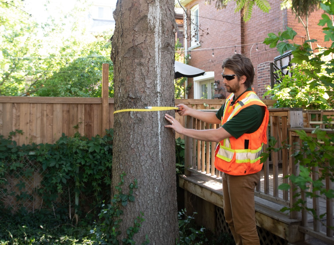
The first step is to measure 1.37m (4'6") up from where the trunk emerges from the ground. This height is known as “breast height”.

image of person measuring the breast height of a tree

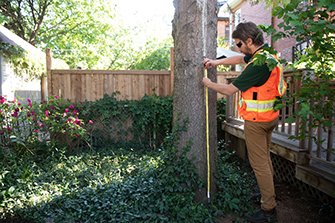
The second step is to measure the circumference of the trunk at breast height and divide that number by 3.14 to convert the trunk circumference to diameter. This measurement is known as “Diameter at Breast Height” or DBH.

image of person measuring the circumference of a tree

For double-stem or multi-stem trees, measure the DBH of each stem similar to the above. The total DBH for the tree is the square root of the sum of each stem diameter squared measured from the outside bark at a height of 1.37m.

  • Example: Tree has three stems:
    • Stem 1 = diameter of 15cm,
    • Stem 2 = diameter of 30cm
    • Stem 3 = diameter of 22cm
  • To calculate the DBH, take the sum of each stem diameter squared.
    • 152 (225) + 302 (900) + 222 (484) = 1609
  • Once you have the sum, take the square root of that number:
    • Square Root (√1609) = 40cm
  • Therefore, the DBH of this 3 stem tree is 40cm.

You need the DBH of a tree to determine what the minimum Tree Protection Zone (TPZ) is around a private or public tree based on Table 1 in the City’s Specification for Tree Protection and Preservation (Table 1 excerpt below – note that the TPZ distances are projected from the outside of the tree all the way around the tree).

Proposed work inside of the TPZ is considered an injury.

Minimum Tree Protection Zones
Trunk Diameter (DBH) Minimum Tree Protection Zone*

<10 cm

1.8 m

11 – 40 cm

2.4 m

41 – 50 cm

3.0 m

51 – 60 cm

3.6 m

61 – 70 cm

4.2 m

71 – 80 cm

4.8 m

81 – 90 cm

5.4 m

91 – 100 cm

6.0 m

>100 cm

6.0 m + 10 cm per 1 cm DBH

*Minimum distances required

  • Example 1: Single Stem
    • If you have a tree that is 55 cm in diameter, all construction activity must be kept a minimum 3.6 m away from the base of the tree in all directions or a tree permit is required.
  • Example 2: Two Stems
    • If you have a tree that has two stems, and the diameter of one is 50cm and the other is 20cm the total DBH is as follows:
    • 502 (2500) + 202 (400) = 2900 | Square root √2900 = 53.85 = 54 cm
    • Therefore, the minimum tree protection zone for this tree is 3.6m
  • Example 3: Three Stems
    • If you have a tree that has three stems, and the diameter of stem one (20cm), stem two (20cm) and stem three (20cm):
    • 202 (400) + 202 (400) + 202 (400) = 1200 | Square root √1200 = 34.64 = 35cm
    • Therefore, the minimum tree protection zone for this tree is 2.4m

Any activity that may disturb, impact or damage a regulated tree. This is typically associated with construction, or where projects are occurring near trees.

Construction activities that can disturb, impact or damage a tree include:

  • Excavation
  • Building
  • Trenching
  • Demolition
  • Boring
  • Placement of fill
  • Storage of soil
  • Change of surface
  • Storage of construction materials
  • Changes to grade
  • Storage of waste or equipment
  • Movement of vehicles and equipment for accessing the area where the work will be occurring

If work such as those listed above will occur within the Tree Protection Zone (TPZ) of a tree, a tree permit for injury may be required and depending on the extent of work within this zone, a tree permit for destruction (removal) may be needed.

Projects that often include one or more of the above activities include but are not limited to: construction or demolition of buildings, pools, driveways, hardscaping, servicing, landscaping, patios, or retaining walls.

Construction activities may have a harmful effect on trees. All parts of a tree can be impacted by construction, including roots (through cutting and soil compaction), trunks (through physical damage such as abrasion), branches (through fractures or poor pruning) and foliage (through chemical or exhaust heat). This damage can lead to decay, structural issues, canopy decline and the eventual death of the tree. Construction damage may not become clear until several years after a project is completed.

Tree protection should be reviewed during the initial stages of your project. The City has tree protection and preservation specifications that apply to trees. These specifications include minimum tree protection zones based on trunk diameter, requirements for protective hoarding, and required procedures where work is to occur within the tree protection zones, such as root pruning and sensitive excavation.

To view a copy of the City’s Standard Specification for Tree Protection and Preservation SS12A, see our forms and documents section at the bottom of this webpage.

Building permit notice

If you are also applying for a building permit, your tree permit application and Forestry review for your project will be part of the Pre-Building Approval Application process. No separate tree permit application is required.

In the event you do not apply for a tree permit with your Pre-Building Approval Application and a tree permit is required for your project, a separate tree permit application may be required using our online form. Staff will provide directions on how to obtain a tree permit based on the information associated with your project.

Pool permit notice

If you are applying for a pool permit, your tree permit application and Forestry review for your project will be part of the Combined Residential Swimming Pool Application process. No separate tree permit application is required as it will be captured as part of the combined process. For more information and to start the pool approval process, please visit our Pool Permits page.

Tree permit application process

If you are not applying for a building permit or a pool permit, and a regulated tree is expected to be injured or destroyed (removed), please submit an online tree permit application using the button below.

Apply for a Tree Permit

  1. Create a login to make an application for a tree permit. Fill out the tree permit eform. You will have the opportunity in the online application (eform) to upload all supporting documents such as photos, consent letter*, owner authorization form (if you are applying on behalf of the owner of the property), and/or an arborist report and/or tree protection plan.

    * A consent letter from the adjacent property owner(s) is required for any removal or injury to a boundary tree or a tree that is not on the subject property (i.e., construction activity occurring within the TPZ of a regulated tree either on the property line or solely in the adjacent lot). The letter of consent shall include:
    • The tree owner’s name and address;
    • Details about the subject tree to be removed or injured (e.g., size, species, location);
    • A statement that clearly indicates that the tree destruction/removal/injury has been disclosed and discussed and their agreement for its removal and/or injury; and
    • The tree owner’s signature and date.
  2. Pay the Application Processing Fee. This fee is collected up front. Where applying to remove a dead tree, a tree with a terminal condition, or a high-risk tree as verified by a qualified tree professional, the processing fee is not required.

  3. Forestry Protection Officer may visit the property address and reach out to ensure that the required information has been received to support the tree permit application.

  4. The Forest Protection Officer will confirm permit conditions and permit issuance fees, including tree protection requirements, compensation for tree loss or securities, as applicable.

  5. Once all the items associated with your application are satisfied, the fees associated with your permit will be collected and your tree permit will be issued.

  6. Once all the items associated with your application are satisfied, the fees associated with your permit will be collected and your tree permit will be issued. Once you have your issued tree permit, you must post the permit card in a visible location on your property. If any issues arise during your project, please contact your Forest Protection Officer.

  7. Once you have obtained your issued tree permit, you must post the permit card in a visible location on your property. If any issues arise during your project, please contact your Forest Protection Officer.

  8. Once you’re finished your project, you must notify the Forest Protection Officer who issued your tree permit before removing any tree protection measures (if installed). A visit will be completed to verify the permit conditions have been met, and if so, you may remove your tree protection. If deficiencies are found, they will need to be fixed before you can remove your tree protection.
  9. If you opted to replant trees, you must notify the Forest Protection Officer with photographs that the trees have been planted. Once this has been verified by staff your replacement tree security deposit will be refunded.

If you require an Arborist Report when applying for a tree permit, you will need one of the following tree professionals to complete it.

  • An International Society of Arboriculture (ISA) Certified Arborist, Municipal Specialist, Qualified Tree Risk Assessor, or Board-Certified Master Arborist (BCMA)
  • A Registered Consulting Arborist (RCA) with the American Society of Consulting Arborists (ASCA)
  • A Registered Professional Forester (RPF)

An Arborist Report from anyone else will not be accepted and will cause delays in receiving your tree permit.

General

  • Tree Permit Application Processing Fee: $54.00 + HST per application
  • Tree Permit Extension/Transfer/Alteration Fee: $54.00 + HST per request
  • Compliance Inspection Fee 1 to 3 Trees: $525.50 per contravention
  • Compliance Inspection Fee: 4 or more Trees: $100 per tree

Private Trees

  • Private Tree Permit 1-3 Tree Removals Fee: $351.50 + HST per application
  • Private Tree Permit 4th Tree Removal Fee: $243.50 + HST per tree
  • Private Tree Permit 5th or more Tree Removal Fee: $135.50 + HST per tree
  • Private Tree Permit Injury Fee: $81.50 + HST per tree
  • Private Tree Replacement (Cash-in-Lieu): $257.50 per replacement tree
  • Replacement Tree Security Deposit: $257.50 per replacement tree

Public Trees

  • Public Tree Removal: 1st tree w/no pre-permit exploratory site visit: $541.00 + HST per tree
  • Public Tree Removal: 1st tree w/ pre-permit exploratory site visit: $641.00 + HST per tree
  • Public Tree Removal: 2 or more trees: $200.00 + HST per tree
  • Public Tree Injury: w/no pre-permit exploratory site visit: $270.50 + HST per tree
  • Public Tree Injury: w/ pre-permit exploratory site visit: $370.50 + HST per tree
  • Public Tree Security 1-10cm: $500 per tree
  • Public Tree Security 11-40cm: $1,000 per tree
  • Public Tree Security 41-75cm: $3,000 per tree
  • Public Tree Security 76cm +: $5,000 per tree
  • Public Tree Replacement: Determined by the Trunk Formula Method per tree

Private trees

Private trees that are removed must be replaced, either through replanting trees, or cash-in-lieu of replacement or a combination of the two. The total amount of replacement trees is based on the tree size removed. Refer to the table below to determine how many trees you will be required to plant.

Trunk Diameter (DBH) of the Tree Removed

Compensation Ratio

20 – 35 cm

2:1

36 – 74 cm

3:1

Greater than or equal to 75 cm

4:1

Replacement trees for private tree removals must be planted within a year of permit issuance or as identified on the tree permit. Replacement trees must be able to grow to a minimum of 4.5 m height at maturity.

When considering which species of trees to replant you must first consider what tree type you are removing. One of your replacement trees must be a similar species to the tree removed. For example, if you remove a deciduous (broadleaf) tree, one of your replacement trees must also be a deciduous (broadleaf) tree.

If opting to replant, there will be a replacement tree security deposit required at the time of your application. Once the trees have been replanted and verified by staff, the deposit will be refunded. The replacement tree security deposit is calculated based on the number of replacement trees required, as it is a deposit per required replacement tree. Refer to the table above to determine the number of replacement trees required and the tree permit fees and securities section of the webpage for the fee and security information.

Replacement trees shall be planted on your private property and not on a property line unless consent from your neighbour was given in compliance with the Forestry Act.

Replacement trees can also be planted on another private lot within the City’s Urban Boundary as approved by staff. If planting on an alternate lot, that lot will need to be identified on the tree replacement plan and we require a letter from the owner of that lot indicating this acceptance. The permit holder will be responsible for paying the tree replacement security deposit, and ensuring the trees are planted. The permit holder will be responsible for notifying staff once the trees are planted to get their deposit refunded. Deposits will only be refunded to the payee of the deposit.

Replacement trees must be maintained in healthy condition.

Replacement trees must be the following minimum sizes at the time of installation:

  • 30 mm caliper if deciduous (broadleaf)
  • 125 cm tall if coniferous (evergreen)

Trees must be tree-form species that achieve a mature height of at least 4.5 m and contribute to long-term urban canopy cover. Dwarf, weeping, top-grafted ornamental, and shrub-form varieties do not qualify.

If there is no room for the replacement trees on your private lot or you opt to not replant, there will be a cash-in-lieu fee per required replacement tree. Refer to the table above to determine the number of replacement trees required and the tree permit fees and securities section of the webpage for the fee and security information. This money will be used toward the planting of trees elsewhere within the City.

Combinations of replacement trees and cash-in-lieu payment is also permitted to meet your tree replacement requirements for private tree removals.

There is no requirement to replant trees where a tree injury permit is issued.

Example: Tree removed has a DBH measurement of 30cm. This will require two replacement trees: Tree Security Deposit = 2 X "Replacement Tree Security Deposit ($)". Once the trees are planted the security deposit will be refunded.

Public trees

Public tree compensation is to be assessed using the Trunk Formula Technique (TFT), specifically the Reproduction Cost Method, in accordance with the Council of Tree & Landscape Appraisers’ Guide for Plant Appraisal, 10th Edition. This nationally recognized methodology determines a tree’s value based on trunk size and applicable depreciation factors, including condition, functional limitations (such as overhead utilities), and external influences (such as pests or site constraints). The calculated value is then evaluated using a unit cost representing the purchase price of the same species from a nursery.

Unit costs are to be derived from the Regional Plant Appraisal Committee (RPAC) Supplemental Guide (2021) to the 10th Edition. When a specific species is not listed, the corresponding genus will be used. If neither the species nor genus appears in the supplemental guide, City staff will be consulted to determine an appropriate unit cost. To obtain a copy of the RPAC supplement, please visit the International Society of Arboriculture Ontario Chapter webpage for more information and to download a copy.

Appraisal submissions will be reviewed by staff as part of the evaluation process. Final determinations regarding compensation are made by the City.

The mature height and spread of trees or hedges should be considered when planning and choosing trees and where to replant them on your property along with the other trees you may already have. A list of some suggested replacement trees is provided below by size:

Small
(Less than 7m)
Medium
(7 m - 15 m)
Large
(Greater than 15 m)
Mountain Maple
Acer spicatum
Balsam Fir
Abies balsamea
White Fir
Abies concolor
Amur Maple
Acer ginnala
Paperbark Maple
Acer griseum
Black Maple
Acer nigrum
Ohio Buckeye
Aesculus glabra
Ruby Red Horse Chestnut
Aesculus x carnea 'Briotii'
Bitternut Hickory
Carya cordiformis
Gray Alder
Alnus incana
Yellow Birch
Betula alleghaniensis
America Beech
Fagus grandifolia
Serviceberry
Amelanchier canadensis
Hackberry
Celtis occidentalis
Maidenhair Tree
Ginkgo biloba
Pawpaw
Asimina triloba
Katsura
Cercidiphyllum japonicum
Tulip Tree
Liriodendron tulipifera
Blue Beech
Carpinus caroliniana
Turkish Hazel
Corylus colurna
Dawn Redwood
Metasequoia glyptostroboides
Eastern Redbud
Cercis canadensis
Copper Beech
Fagus sylvatica var. purpurea
White Spruce
Picea glauca
American Yellowwood
Cladrastis kentukea
Shademaster Honeylocust
Gleditsia triacanthos var. inermis ‘Shademaster’
White Pine
Pinus strobus
Pagoda Dogwood
Cornus alternifolia
Sweetgum
Liquidambar styraciflua
Sycamore
Platanus occidentalis
Saucer Magnolia
Magnolia x soulangeana
Black Gum
Nyssa sylvatica
Bur Oak
Quercus macrocarpa
Kwanzan Cherry
Prunus serrulata 'Kwanzan'
Ironwood
Ostrya virginiana
English Oak
Quercus robur
Choke Cherry
Prunus virginiana
Sassafras
Sassafras albidum
Red Oak
Quercus rubra
Mountain Ash
Sorbus aucuparia
Linden
Tilia cordata
Hemlock
Tsuga canadensis
Ivory Silk Lilac
Syringa reticulata ‘Ivory silk’
Japanese Zelkova
Zelkova serrata
Elm x Morton
Ulmus davidiana var. japonica 'Morton'

*Sizes are approximate. You will need to confirm size and details about the tree at the time of purchase with the nursery and/or store.

The City of Burlington’s Forestry department administers a free tree giveaway event where homeowners and businesses in Burlington can sign up to get a free tree to pick up and plant on their property. The free tree giveaway event is scheduled once per year in the spring. Only one free tree is provided per property address, while supplies last.

As part of updates to the City’s Private Tree By-law program in April 2022, the City will offer you an opportunity to obtain a free tree where a dead tree, or a tree with a terminal condition is removed to replace the canopy. You will have the option to sign up for notification of tree giveaways through the online tree permit application form. By selecting yes in the form, you will be added to a list of recipients to be contacted prior to the free tree giveaway event with details about the trees and how to obtain one.

For the latest information about the next free tree giveaway, please visit Get Involved Burlington to subscribe to notifications about project updates.

For more details please visit significant tree maintenance rebate program page.